Strategic Analysis of Aviation and Aerospace Scholarship Opportunities for 2026: National Pipelines and Alabama Regional Specializations
The aviation and aerospace sectors enter 2026 facing a structural paradox defined by unprecedented technological advancement and a persistent, high-stakes workforce deficit. As the global demand for air travel continues to expand and the aerospace manufacturing sector pivots toward advanced air mobility and sustainable propulsion, the necessity for a robust talent pipeline has never been more urgent. For high school and college students in the United States, the 2026 scholarship landscape serves as a critical mechanism for navigating the substantial financial barriers associated with flight training, technical certification, and specialized academic degrees. This report provides a comprehensive examination of the available funding programs for the 2026 academic year, with a specialized focus on the localized opportunities within the state of Alabama, a region that continues to exert significant influence on the national aerospace trajectory.
The Macro-Economic Imperative: Funding the 2026 Workforce
The primary challenge defining the 2026 aviation environment is the cost-of-entry crisis. Accelerated pilot training programs frequently demand investments ranging from to , creating a high-risk environment for students without significant institutional support.1 Consequently, the 2026 scholarship market is best understood as a decentralized network of five overlapping funder classes: professional associations, industry-sponsored pipeline programs, philanthropic foundations, military and governmental accessions, and localized community organizations.2
A discernible trend in the 2026 cycle is the shift from broad, merit-based grants toward "bottleneck-focused" awards. Funder organizations have increasingly identified specific milestones—such as the private pilot written exam, the initial solo flight, and the instrument rating—as points where student attrition is highest due to financial exhaustion.2 By targeting these specific hurdles, the scholarship ecosystem in 2026 aims to maximize the "Return on Investment" (ROI) for the industry by ensuring that funded candidates possess the "stage-appropriateness" required to successfully complete their certifications.2
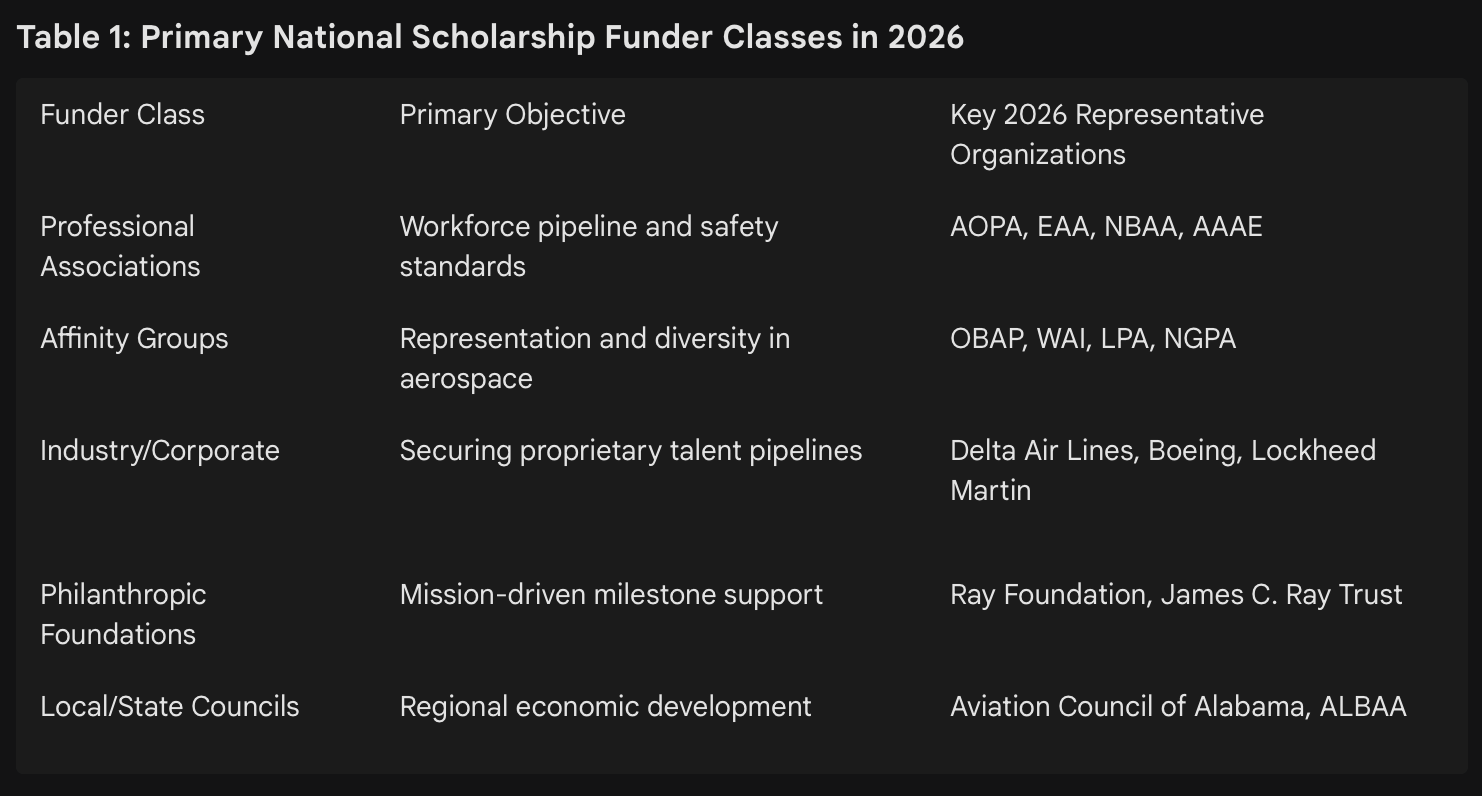
Aviate Alabama Primary National Scholarship Funder Classes in 2026
Alabama-Specific Aviation Infrastructure and Funding
Alabama remains a pivotal hub for aerospace education and training, supported by a dense network of research universities, community colleges, and a proactive state aviation council. The regional strategy for 2026 emphasizes the integration of secondary and post-secondary pathways, ensuring that students in Alabama have access to specialized aid that remains restricted to the state’s geographic boundaries.
The Aviation Council of Alabama (ACA) Framework
The Aviation Council of Alabama (ACA) represents the cornerstone of state-level support for aspiring aviators and aerospace professionals. For the 2026 academic year, the ACA has structured its scholarship program to address the three primary pillars of the industry: flight, management, and maintenance.13
The 2026 ACA program offers four distinct awards, each valued at .13 While the monetary value may seem modest compared to the total cost of training, these awards are highly effective when "stacked" with university-specific merit aid or corporate grants. The application deadline for these awards is March 31, 2026, with a formal announcement of winners scheduled for June 30, 2026.13
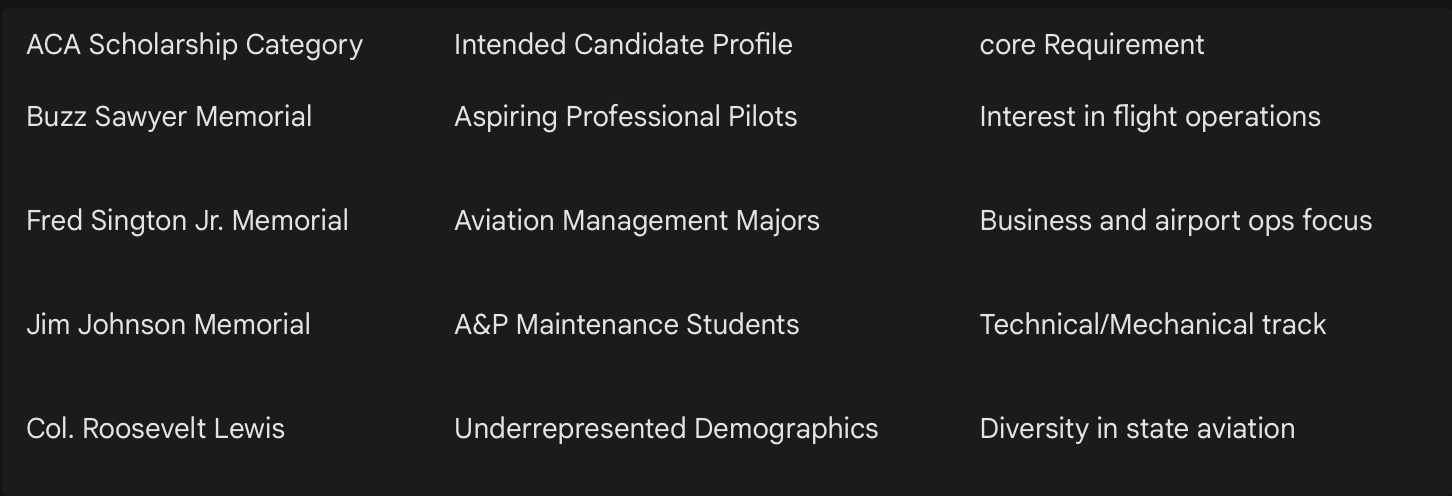
The ACA selection process is characterized by a commitment to merit and need, requiring a 250-word descriptive essay and two professional recommendations.13 A significant operational detail for 2026 is that ACA membership is not a prerequisite for selection, though the funds must be disbursed directly to the bursar’s office of an accredited institution.13
Alabama Business Aviation Association (ALBAA) and Localized Access
Supplementing the ACA's efforts, the Alabama Business Aviation Association (ALBAA) targets students specifically interested in the corporate and general aviation sectors. ALBAA’s 2026 strategy is geographically restrictive, requiring applicants to both live in and attend training within the state of Alabama.14 This geographic filter significantly reduces the competitive pool, making ALBAA one of the highest-probability options for Alabama-based students.
The ALBAA provides three main pathways for 2026:
Flight Scholarships: Reserved for aspiring business aviation pilots who already possess at least a Private Pilot License (PPL) and are actively training at an Alabama flight school.14
Non-Flight Scholarships: Targeted at the "behind-the-scenes" professionals, including maintenance technicians, schedulers, dispatchers, and aircraft sales associates.14
Continuing Education: Designed for existing professionals in the Alabama business aviation market seeking advanced certifications or professional development.14
Institutional Deep-Dive: Alabama Higher Education
The 2026 funding environment in Alabama is heavily anchored by the state’s major universities, which utilize sophisticated scholarship management systems to distribute both internal and external aid.
Auburn University: The AUSOM Platform
Auburn University’s School of Aviation is a premier destination for aerospace education, utilizing the Auburn University Scholarship Opportunity Manager (AUSOM) to centralize its departmental awards. For the 2026-2027 academic year, the priority deadline for scholarship consideration is February 16, 2026.15 Incoming students must be accepted by December 1 to receive early action consideration for these funds.15
Auburn’s internal merit-based system provides a critical financial foundation for resident students, with tiers determined by high school GPA and standardized test scores.
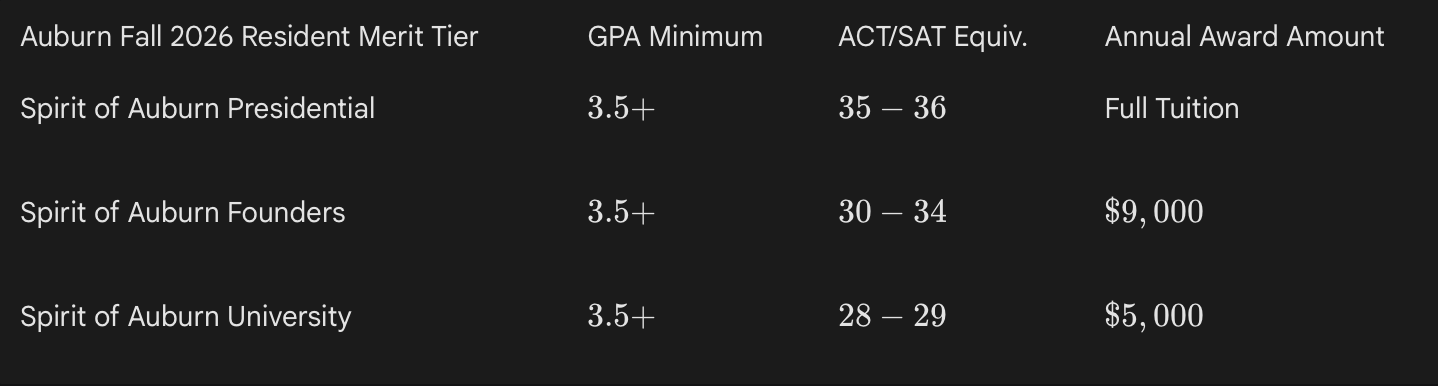
Auburn Fall 2026 Resident Merit Aviation Scholarship
In addition to merit-based awards, Auburn aviation students are frequent recipients of high-value industry awards, such as the ISTAT Foundation’s AerCap Scholarship, which focuses on aviation finance and leasing.18 Auburn’s strong ties to the Alabama Community College System and Athens State University further facilitate a transfer pathway that is supported by specialized transfer scholarships for those with a minimum GPA.13
Jacksonville State University (JSU): The Gamecock Advantage
Jacksonville State University offers an automated merit-based scholarship system that is particularly advantageous for high school seniors entering an aviation-related program. JSU’s 2026 strategy relies on the "Jax App" platform, with a centralized deadline of February 1, 2026.19
For students who do not qualify for the top-tier honors awards, JSU provides a structured merit ladder:
Gamecock Achievement: Awards up to annually for students with a GPA.20
Gamecock Success: Provides for students in the GPA range.20
Gamecock Opportunity: Targeted at students with lower GPA ranges (), providing entry-level assistance of .20
The JSU Honors Scholarship remains the most competitive, covering tuition, housing, books, and fees, with a total four-year value exceeding .19 This scholarship requires a GPA and a ACT score, as well as an interview with the Honors Board.21
National Pilot Training Foundations: AOPA and EAA
The most substantial funding for primary flight training in 2026 comes from the Aircraft Owners and Pilots Association (AOPA) and the Experimental Aircraft Association (EAA). These organizations utilize a national network of donors to fund hundreds of students annually.
AOPA Foundation: "You Can Fly" Initiatives
AOPA’s 2026 scholarship cycle is divided into two distinct periods, allowing students flexibility in their training timelines.3
Spring 2026 Period: Applications are open from April 1 to June 30, with awards granted in September.3
Fall 2026 Period: Applications are open from October 1 to December 31.3
The AOPA Foundation You Can Fly High School Scholarship is the flagship program for students aged . In 2026, the foundation aims to award at least scholarships of each.3 A critical differentiator for AOPA in 2026 is the requirement that students must have passed the FAA Private Pilot written knowledge exam prior to submitting their application.3 This reflects a broader industry move toward funding students who have already invested the effort to clear initial academic hurdles, thereby reducing the "wash-out" rate.
EAA and the Ray Aviation Scholarship Program
The EAA Aviation Foundation manages a diverse portfolio of scholarships that support both flight training and collegiate academic pursuits. For the 2026 cycle, the application window closes on December 19, 2025, with notifications occurring in early March 2026.22
The Ray Aviation Scholarship is perhaps the most unique mechanism in the 2026 landscape. Funded by the Ray Foundation and administered through local EAA chapters, this program provides up to for primary flight training.11 The scholarship is designed for students aged for powered flight or for gliders.11
In Alabama, the involvement of local chapters is vital. EAA Chapter 152 in Birmingham and Chapter 190 in Huntsville serve as conduits for these funds.11 Ray Scholars are expected to complete their training within 12 months and solo within 4 months of their start date.24 Additionally, they must commit to two hours of chapter volunteer service per month, reinforcing the mentorship-based nature of the program.24
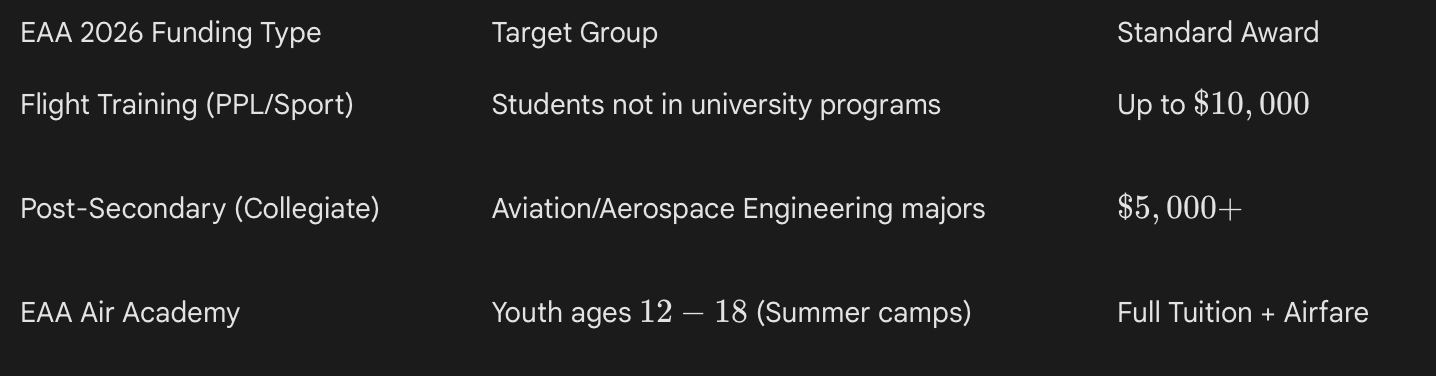
EAA 2026 Aviation Scholarship Funding by Target Group - Presented by Aviate Alabama
Corporate Pipelines and OEM Sponsorships
Major aerospace corporations have moved beyond simple philanthropy to establish robust talent acquisition pipelines disguised as scholarship programs. In 2026, these programs are essential for students targeting careers with original equipment manufacturers (OEMs) or major air carriers.
The Boeing Scholars Program: A Multi-Year Cohort Model
Boeing provides structured support through partner universities, creating "cohorts" of students who receive not just funding, but direct access to the corporation’s internal culture. At Embry-Riddle Aeronautical University, the Boeing Scholars Program awards per year for two years to students pursuing aeronautical science or aviation maintenance.8 The 2026 deadline for this program is March 15, and it includes formal mentorship and exclusive trips to Boeing facilities.8
A similar program exists at Washington State University (WSU) Everett, offering annual scholarships. The intent of these programs is to cultivate the next generation of innovators who will remain with the company for the duration of their careers, thereby stabilizing Boeing’s internal workforce.30
Lockheed Martin: Bridging the Vocational Gap
Lockheed Martin addresses the critical shortage of technical and maintenance staff through its Vocational Scholarship Program. In 2026, this program will award up to to as many as recipients.9 The application deadline is April 1, 2026.9 Unlike many university-bound programs, this award is specifically for students in vocational technical schools, trade schools, or two-year community colleges.9
Eligible fields for the Lockheed Martin award in 2026 include:
Advanced Manufacturing
Engineering Technologies
Mechanic and Repair Technologies (including A&P)
Cybersecurity and Data Analytics 9
Delta Air Lines Propel and the Middle Georgia State Partnership
Delta Air Lines has expanded its Propel Career Path Program into a comprehensive ecosystem that targets students as early as high school. For Alabama students, Delta’s partnership with Middle Georgia State University is particularly relevant. Through a million grant from the Delta Air Lines Foundation, students in this dual-enrollment program are eligible for scholarships covering full tuition, fees, and flight instruction.10
The Delta Propel strategy in 2026 offers a "guaranteed path" to the Delta flight deck through a conditional job offer to Endeavor Air, Delta’s subsidiary.31 Students must be enrolled in an AABI-accredited flight program and maintain a high standard of performance to remain in the pipeline.31
Diversity, Equity, and Inclusion (DEI) and Affinity Group Funding
A significant portion of the 2026 scholarship market is dedicated to increasing representation for underrepresented groups in the aerospace industry.
Organization of Black Aerospace Professionals (OBAP)
OBAP’s scholarship program is one of the most robust in the industry, having awarded over million since its inception.1 For 2026, the organization emphasizes its "STAR" method panel interview as a key part of the selection process.1
Application Requirements: Applicants must have been an active OBAP member for at least three months prior to applying and must reside in the United States.1
Volunteer Service: A minimum of 10 hours of verified OBAP volunteer engagement is required for 2026 candidates.1
Specific 2026 Awards: Notable offerings include the Alaska Airlines Pilot Scholarship ($2,500) and the Epic Flight Academy Aircraft Mechanic Scholarship ($20,000).32
Women in Aviation International (WAI)
WAI continues to set a benchmark for diversity-focused funding, with 2026 scholarship values exceeding .5 The general application window for the 2026 cycle closes in October 2025, but professional development awards, such as the WAI Harvard Emerging Leaders Scholarship, have a deadline of January 15, 2026.34
A hallmark of WAI scholarships in 2026 is the requirement for two professional recommendation letters (no family members permitted) and a 500-word essay focused on passion for aviation and community involvement.34
Table 2: Comparative Analysis of DEI-Focused Aviation Scholarships 2026
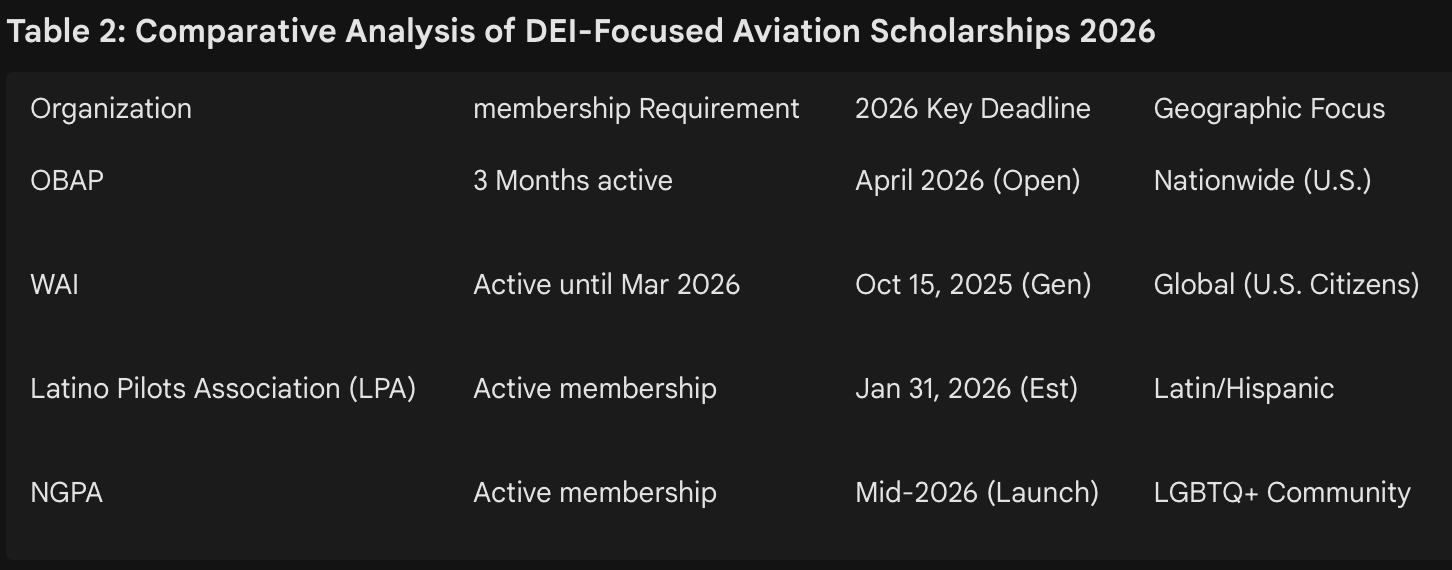
Table 2: Comparative Analysis of DEI-Focused Aviation Scholarships
Technical Specializations: Maintenance and Air Traffic Control
While flight training often dominates the discourse, the 2026 cycle includes significant funding for the "backbone" of the industry: maintenance technicians and air traffic managers.
Professional Aviation Maintenance Association (PAMA)
PAMA, in coordination with industry partners like JSFirm and PistonPower, offers several awards targeted at A&P students. The deadline for most PAMA 2026 awards is March 2, 2026.37
JSFirm.com Aviation Mechanic Student Award: Provides to an eligible student in an FAA Part 147 school.37
Jack D. Prewitt Memorial Scholarship: Offers two awards of annually.39
Choose Aerospace/SkillPointe: A massive program launched for 2026, providing tuition awards plus tools and certification exam vouchers.40
Air Traffic Control Association (ATCA)
ATCA provides high-value scholarships for those pursuing careers in air traffic management. These awards, which can range from to , are highly sought after.2
Full-Time Employee Student Scholarship: A award due June 1, 2026, for employees seeking advanced degrees in ATC.41
Buckingham Memorial Scholarship: Targeted at children of ATC specialists, requiring U.S. citizenship and half-to-full-time enrollment in a degree program.41
ATCA Full-Time Student Scholarship: Due May 15, 2026, for students in ATC programs listed by the FAA.43
Strategic Application Architectures for 2026
Successfully securing an aviation scholarship in 2026 requires more than academic excellence. Scholarship committees have become increasingly forensic in their evaluation of "professional commitment" and "safety culture."
The "Stage-Appropriate" Advantage
The most significant competitive advantage for a 2026 candidate is demonstrating they are ready to use the funds immediately. This is referred to as being "stage-appropriate." For a flight student, this means having:
A Current Medical Certificate: Preferably a First Class Medical, even for private pilot students, to prove they are medically eligible for an airline career.3
Passed the FAA Written Exam: As noted by AOPA and NGPA, passing the knowledge test before applying signals that the student is a low-risk investment for the committee.3
A Valid Training Plan: Many 2026 applications (e.g., NBAA) require students to "rank their preferences" for training or "outline their goals" for the next 1 to 5 years.7
The Role of Mentorship and Recommendations
Recommendations are a critical pivot point in 2026. General letters from family or friends are universally rejected.36 Successful applicants secure letters from:
Certified Flight Instructors (CFIs): Who can attest to the student’s work ethic in the cockpit.
Airport Managers/A.A.E.s: Especially for the AAAE Foundation scholarships, where endorsement from an Accredited Airport Executive can increase the award amount to over .45
Community Leaders: Who can speak to the applicant’s volunteer service, a core requirement for OBAP and EAA Ray Scholarships.1
Table 3: Master Timeline of Major Aviation Scholarship Deadlines for 2026
Date
scholarship/Organization
Primary Criteria
Dec 1, 2025
NBAA AMT Maintenance
Maintenance students 44
Dec 19, 2025
EAA General Cycle
Flight/Academic 22
Jan 6, 2026
NBAA International Operators
Career expansion 47
Jan 15, 2026
WAI Professional Development
Experience/Leadership 34
Jan 31, 2026
AIAA Scholarships
Engineering/Design 2
Jan 31, 2026
Auburn Aviation (AAA)
Local flight/EAA 28
Feb 1, 2026
JSU Honors/Jax App
Multi-year academic 19
Feb 16, 2026
Auburn University (AUSOM)
Internal departmental 15
Mar 2, 2026
PAMA Maintenance Awards
Technical students 37
Mar 13, 2026
AAAE Foundation
Airport management 45
Mar 15, 2026
Aero Club of Washington
General aviation 49
Mar 31, 2026
Aviation Council of Alabama
AL state residents 13
Apr 1, 2026
Lockheed Martin Vocational
Trade/Technical 9
Jun 1, 2026
ATCA Buckingham
Children of ATC 41
Jun 30, 2026
AOPA Spring Cycle Close
Primary certificates 3
Conclusion: Navigating the 2026 Alabama Aerospace Pipeline
The 2026 aviation scholarship ecosystem is a dense but navigable network that offers substantial rewards to students who approach the process with professional rigor. For Alabama residents, the geographic concentration of aerospace industry assets—from the research facilities at Auburn to the vocational focus of the Alabama Community College System—creates a localized advantage that is unmatched in other regions.
The key to success in 2026 lies in the "stacking" of awards. A student pilot in Birmingham should not only apply for the national AOPA scholarship but concurrently target the Aviation Council of Alabama’s Buzz Sawyer Memorial, the Alabama Business Aviation Association’s flight grant, and the local EAA Chapter 152 Ray Scholarship. By aligning their FAA written exam results with these deadlines and securing endorsements from the state’s network of airport executives and instructors, a candidate can significantly mitigate the costs of their professional development. As the industry continues to evolve, these scholarships remain the primary vehicle for ensuring that the cockpit and the hangar remain accessible to the most capable, regardless of their financial starting point.
