

VFR Weather Minimums: Everything Student Pilots Need to Know (+ Free Checklist)
One of the most critical decisions you'll make as a pilot happens before you ever start the engine: determining whether the weather is safe for flight.
Understanding VFR (Visual Flight Rules) weather minimums isn't just about memorizing numbers for your checkride—it's about developing the judgment that will keep you safe throughout your entire flying career.
In this comprehensive guide, we'll break down everything you need to know about weather minimums, from basic FAA requirements to establishing your own personal minimums that go beyond the regulatory baseline.
What Are VFR Weather Minimums?
VFR weather minimums are the minimum weather conditions required by the Federal Aviation Administration (FAA) for pilots to fly under Visual Flight Rules. These minimums ensure you have adequate visibility and clearance from clouds to see and avoid other aircraft, obstacles, and terrain.
Think of them this way: VFR flight means you're navigating by looking out the window, not relying on instruments. You need to be able to see where you're going and who else might be sharing your airspace.
Why Weather Minimums Matter More Than You Think
Here's a sobering fact: weather-related accidents account for approximately 25% of general aviation accidents, and many of these involve VFR pilots who encountered conditions beyond their skill level.
The problem isn't usually that pilots don't know the minimums—it's that they treat minimums as targets rather than absolute boundaries.
As the aviation safety saying goes: "FAA minimums are for the FAA's most experienced pilots on their best day. What are YOUR minimums?"
Understanding the Basic VFR Weather Minimums
The FAA's weather minimums vary based on the airspace you're flying in. Here's what you need to know:
Class B Airspace (Around Major Airports)
Visibility: 3 statute miles
Cloud Clearance: Clear of clouds
Class B is the most lenient for cloud clearance because of the high level of radar service and traffic separation provided by ATC.
Class C and D Airspace (Towered Airports)
Visibility: 3 statute miles
Cloud Clearance: 500 feet below, 1,000 feet above, 2,000 feet horizontal
These are the minimums most student pilots memorize first, as they apply to many training airports.
Class E Airspace
This is where it gets more complex:
At or above 10,000 feet MSL:
Visibility: 5 statute miles
Cloud Clearance: 1,000 feet below, 1,000 feet above, 1 statute mile horizontal
Below 10,000 feet MSL:
Visibility: 3 statute miles
Cloud Clearance: 500 feet below, 1,000 feet above, 2,000 feet horizontal
Class G Airspace (Uncontrolled)
Class G minimums change based on altitude AND time of day:
1,200 feet or less above the surface (Day):
Visibility: 1 statute mile
Cloud Clearance: Clear of clouds
1,200 feet or less above the surface (Night):
Visibility: 3 statute miles
Cloud Clearance: 500 feet below, 1,000 feet above, 2,000 feet horizontal
Above 1,200 feet but below 10,000 feet MSL:
Same as Class E below 10,000 feet
The Problem with Flying at Legal Minimums
Let's be honest: flying in exactly 3 miles visibility with a 1,000-foot ceiling might be legal, but for most pilots—especially those with less than 500 hours—it's not smart.
Here's why:
1. Visibility is deceptive. What looks like 3 miles on a hazy day might actually be less. Without reliable reference points, most pilots overestimate visibility.
2. Things happen fast. In marginal weather, your workload skyrockets. Navigation becomes harder, you're constantly scanning for deteriorating conditions, and there's less time to react to unexpected situations.
3. Options disappear. Lower ceilings mean fewer places to go if things get worse. You might find yourself trapped between lowering clouds and rising terrain.
4. Other pilots might be IFR. That 1,500-foot ceiling you're safely under? An IFR aircraft might be descending through it on an approach, and neither of you can see the other.
Establishing Your Personal Minimums
Smart pilots establish personal minimums that provide a safety buffer above FAA requirements. Your personal minimums should be based on:
Your total flight experience
Recent flying activity (currency)
Familiarity with the route and area
Aircraft equipment and capabilities
Time of day (night flying requires higher minimums)
Recommended Personal Minimums by Experience Level
Student Pilot:
Ceiling: 3,000 feet AGL minimum
Visibility: 5+ miles
Winds: 15 knots or less
Crosswind: 7 knots or less
No night flight in marginal conditions
New Private Pilot (0-100 hours):
Ceiling: 2,500 feet AGL minimum
Visibility: 5+ miles
Winds: 20 knots or less
Crosswind: 10 knots or less
Experienced VFR Pilot (100-500 hours):
Ceiling: 2,000 feet AGL minimum
Visibility: 3+ miles
Winds: 25 knots or less
Crosswind: 12 knots or less
Proficient Pilot (500+ hours):
Ceiling: 1,500 feet AGL minimum
Visibility: 3 miles (VFR minimum)
Winds: 30 knots or less
Crosswind: 15 knots or less
Even with thousands of hours, many professional pilots maintain personal minimums well above FAA requirements for VFR flight.
The Weather Decision-Making Process
Making a go/no-go decision should follow a systematic process:
1. Get a Complete Weather Briefing
Use official sources like 1800WxBrief.com or ForeFlight. Check:
Current conditions (METARs)
Forecasts (TAFs)
Area forecasts
AIRMETs and SIGMETs
Pilot reports (PIREPs)
Winds aloft
NOTAMs
2. Evaluate Trends
Is the weather improving or deteriorating? A 2,000-foot ceiling that's rising is very different from one that's falling.
3. Consider Your Alternatives
What's your planned alternate airport?
If weather deteriorates en route, where can you land?
Do you have a plan B (and C)?
4. Assess Your Own State
Apply the IMSAFE checklist:
Illness
Medication
Stress
Alcohol
Fatigue
Emotion
Marginal weather and a less-than-optimal personal state is a dangerous combination.
5. Make a Conservative Decision
When in doubt, don't go. The aircraft will still be there tomorrow, and the weather might be better.
Weather Hazards That Should Always Be No-Go
Certain weather conditions should always result in canceling or delaying your flight:
Thunderstorms: Never fly through or near thunderstorms. The FAA recommends staying at least 20 miles away. Embedded thunderstorms (hidden in cloud layers) are especially dangerous.
Icing Conditions: Unless your aircraft is certified for flight into known icing (FIKI), any forecast or actual icing should be an automatic no-go.
Mountain Obscuration: Flying in mountains with low clouds or reduced visibility creates extreme CFIT (Controlled Flight Into Terrain) risk.
Strong Wind Shear: Sudden changes in wind speed or direction can cause dangerous loss of airspeed or altitude, especially near the ground.
Low Visibility/Ceilings: Getting caught in deteriorating visibility can lead to spatial disorientation, even for experienced pilots.
Special VFR: When You Can Bend the Rules (Sort Of)
Special VFR (SVFR) allows you to operate in controlled airspace when conditions are below basic VFR minimums, but only with ATC clearance and specific requirements:
Requirements:
Minimum 1 mile visibility
Remain clear of clouds
ATC clearance required
Night SVFR requires an instrument rating
When it makes sense:
Departing under a scattered layer that breaks up quickly
Landing at your home airport when conditions are just below VFR minimums
You're familiar with the area and conditions are stable or improving
When it doesn't:
You're a low-time pilot
Conditions are deteriorating
You're unfamiliar with the area
There's any doubt about your ability to maintain visual contact with the ground
Practical Tips for Weather Decision-Making
Start conservatively. It's easier to relax your personal minimums as you gain experience than to survive pushing beyond your capabilities early on.
Track the weather days in advance. Don't wait until the morning of your flight to check weather. Start monitoring trends 2-3 days out.
Call for updates. Weather can change rapidly. If your flight is more than an hour away, get an updated briefing before you head to the airport.
Talk to other pilots. PIREPs (pilot reports) are gold. They tell you what conditions are actually like, not just what's forecast.
Have a personal minimums card. Write down your minimums and keep them in your flight bag. When you're tired or feeling pressure to complete a flight, that card can help you make the right decision.
Practice the 180-degree turn. If you encounter unexpected weather en route, you need to be proficient at turning around. Practice this skill regularly.
The Get-Home-Itis Trap
One of the most dangerous psychological factors in aviation is "get-home-itis"—the pressure to complete a flight because of schedule, passengers, or other commitments.
This pressure causes pilots to:
Minimize weather hazards
Rationalize poor conditions
Continue VFR into IMC (Instrument Meteorological Conditions)
Skip proper weather briefings
The cure? Have a backup plan. If you're flying somewhere for an important event, plan to arrive a day early or have alternative transportation arranged. Never let external pressure override your weather minimums.
Building Your Weather Knowledge
Understanding weather minimums is just the beginning. Great pilots develop a deep understanding of meteorology:
Take weather courses beyond what's required for your certificate
Read books like "Weather Flying" by Robert N. Buck
Study accident reports related to weather
Fly with experienced pilots and ask them about their weather decision-making
Use every flight as a learning opportunity
Your Next Steps
Weather decision-making is a skill that develops over a lifetime of flying. Start building that skill now by:
Establishing your personal minimums based on your current experience level
Practicing weather briefings even when you're not flying
Studying weather theory to understand what you're seeing in forecasts
Building experience in good weather before gradually expanding your envelope
Ready to take your weather knowledge to the next level?
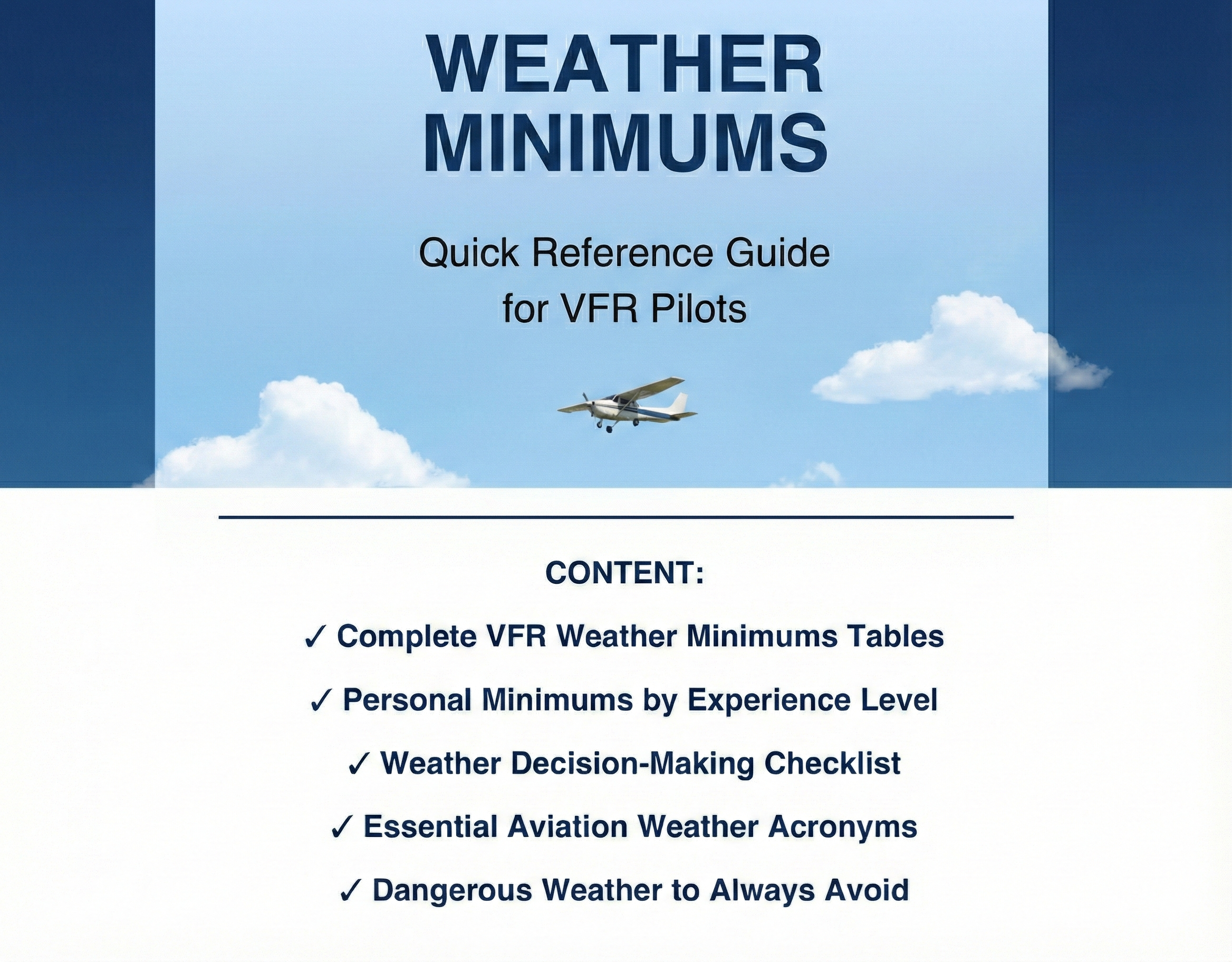
We've created a comprehensive Weather Minimums Quick Reference Guide that includes:
✓ Complete VFR weather minimums tables for all airspace classes
✓ Recommended personal minimums by experience level
✓ Weather decision-making checklist
✓ Essential aviation weather acronyms (METAR, TAF, PIREP, etc.)
✓ Dangerous weather phenomena to always avoid
✓ Quick reference for Special VFR operations
DOWNLOAD YOUR FREE WEATHER MINIMUMS GUIDE
Aviate Alabama Weather & Safety Guide is a concise, pilot-focused reference that simplifies critical aviation weather and safety information into one easy-to-use resource. It explains essential reports like PIREPs (real-time pilot weather reports), AIRMETs (moderate weather advisories), SIGMETs (severe weather alerts), and NOTAMs (vital flight hazards and operational notices), helping pilots make smarter, safer decisions.
The guide also includes a curated list of trusted aviation weather tools—from official FAA briefings to industry-leading flight planning apps—giving pilots reliable sources for planning and in-flight awareness. Designed to promote safer operations, better judgment, and confident flying, this resource supports Aviate Alabama’s mission: Fly Safe. Fly Smart. Fly with Confidence.
Final Thoughts: Respect the Weather
Weather has humbled pilots since the dawn of aviation. The good news is that with proper training, conservative decision-making, and respect for atmospheric forces, you can enjoy a long and safe flying career.
Remember: The best pilots aren't the ones who can fly in the worst weather. They're the ones who know when NOT to fly.
Your passengers, your family, and your future self will thank you for every conservative weather decision you make.
Stay safe up there, and always remember—the sky will still be there tomorrow.
About Aviate Alabama
Want more free aviation resources? Check out our complete collection of pilot guides:
Pre-Flight Checklist for Student Pilots
Flight Training Cost Guide and Budget Planner
Getting Started in Aviation: Complete Beginner's Guide
Fly safe, fly smart, and keep learning!
