

The Gulfstream Subsidy: How Southern Company Executives Fly Private on a First-Class Budget
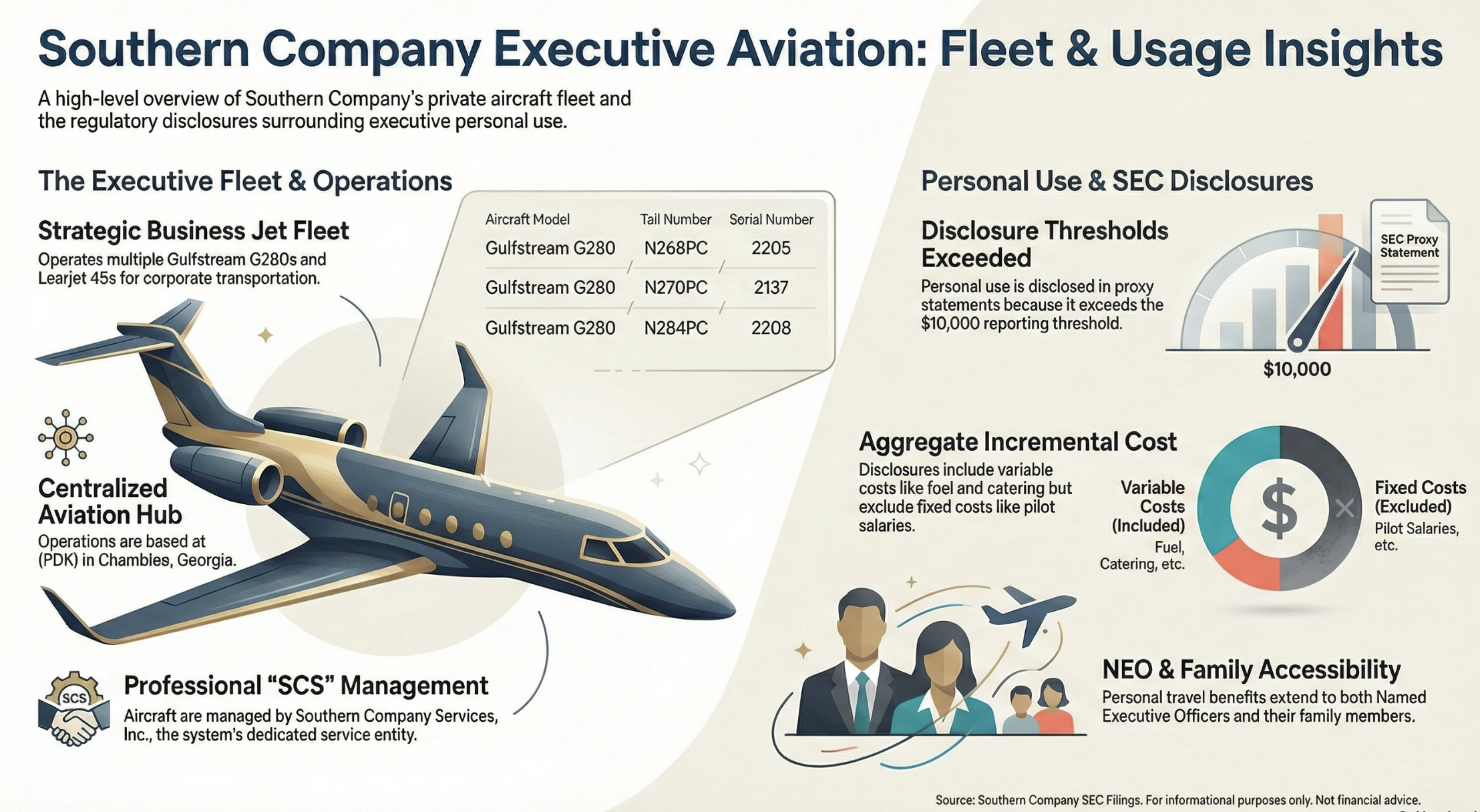
For the millions of families across the Southeast paying their monthly utility bills, Southern Company is a provider of essential, grounded infrastructure. But for the elite few at the top of the corporate ladder, the company’s "service" extends well into the stratosphere. Buried within the fine print of the 2024 Proxy Statement is a paper trail revealing a sophisticated, world-class aviation operation that functions as both a corporate tool and a high-value lifestyle subsidy for top brass. By analyzing SEC filings and aviation records, we can pull back the curtain on how Southern Company’s leadership travels—and how the "incremental cost" accounting creates a massive pricing paradox for the executives involved.
A "World-Class" Fleet Operated by Southern Company Services, Inc.
Southern Company doesn't just charter planes; it maintains a dedicated aviation arm branded as "Southern Company Aviation." The fleet is held and operated by Southern Company Services, Inc. (SCS), the system’s internal service entity. This organization operates out of a high-profile base at Peachtree DeKalb Airport (PDK) in Chamblee, Georgia.
The fleet is comprised of top-tier hardware designed for long-range luxury and speed:
- Gulfstream G280s: A fleet of at least three super-midsize business jets, identifiable by tail numbers N268PC, N270PC, and N284PC.
- Learjet 45s: Aviation records and recruitment materials confirm these nimble business jets round out the fleet, providing a variety of options for regional and national travel.
While the company markets this department internally as a "world-class business aviation organization" that prioritizes "work-life balance" for its flight crews, the forensic reality is a multi-million dollar asset pool maintained for a tiny fraction of the company's workforce.
It’s a Family Affair: Subsidized Luxury as a Perquisite
In the world of corporate governance, "personal use" is the ultimate red flag for investors looking for stealth compensation. Southern Company’s filings make no secret of the fact that these jets are more than just mobile boardrooms; they are explicitly provided as a lifestyle asset for executives and their kin.
"Perquisites currently provided generally include an annual cash stipend for non-accountable expenses and personal and family travel on Company-owned aircraft."
This disclosure transforms the fleet from a business necessity into a significant family benefit. By extending flight privileges to family members, the company provides a service that would cost a private citizen tens of thousands of dollars per flight hour on the open market—effectively turning a utility company into a subsidized private travel agency for the leadership's inner circle.
The Pricing Paradox: Private Flights at "Spirit Airlines" Prices
The most glaring discrepancy in executive aviation is the "Pricing Paradox." Southern Company uses the "Incremental Cost" method for SEC reporting, while executives likely reimburse the company using SIFL (Standard Industry Fare Level) rates.
This creates a "First-Class Price, Private Reality" scenario. Under this system, an executive flying on a private Gulfstream G280—enjoying total privacy, no security lines, and a custom schedule—effectively pays a rate approximating a commercial first-class ticket.
- The Company’s Tab: Southern Company (and, by extension, the SCS operating budget) absorbs the massive overhead, including fuel, trip-related maintenance, crew travel (hotels and meals), landing fees, and catering.
- The Subsidy: Critically, the executive pays $0 toward the "fixed costs"—the multimillion-dollar purchase price of the aircraft, pilot salaries, hangar fees, and insurance.
The company pays these millions in fixed costs regardless of whether the plane is flying a CEO to a board meeting or a family member to a vacation. The executive simply picks up the "incremental" change, leaving the bulk of the luxury infrastructure to be subsidized by the company.
The $10,000 Transparency Trigger
We only know about these high-flying perks because of the SEC’s disclosure "tripwires." Public companies must report perquisites in the "All Other Compensation" column if the total value exceeds 10,000** for any Named Executive Officer (NEO). If a single perk—like personal jet use—exceeds **25,000, it must be specifically itemized.
The fact that personal aircraft usage is explicitly cited in the 2024 Proxy Statement serves as a forensic confirmation: the value of these flights has officially crossed these high reporting thresholds. This isn't an occasional convenience; it is a material component of the executive compensation package that shareholders (and regulators) are required to see.
**
The Roster of Frequent Flyers
**
The keys to the SCS fleet are held by a select group of "Named Executive Officers." The current roster reflects a period of significant leadership transition, yet the aviation perks remain a constant:
- Christopher C. Womack: Chairman, President, and CEO (became President in March 2023, CEO in May 2023, and Chairman in December 2023).
- Daniel S. Tucker: Executive Vice President and CFO.
- Kimberly S. Greene: Executive Vice President and COO.
- Melissa K. Caen: Senior Vice President and Chief Legal Officer.
- Thomas A. Fanning: Former Chairman and CEO (Retired December 2023).
To put the value of these perks in context, the 2024 median disclosed aircraft perquisite for S&P 100 companies stands at $210,000. By listing these benefits as a standard part of the "NEO Transitions," Southern Company signals that these high-altitude rewards are a permanent fixture of their corporate culture, regardless of who is in the cockpit.
Conclusion: The Cost of Connection
Southern Company justifies its "world-class" aviation department as a tool for efficiency and "work-life balance." However, an investigative look at the numbers suggests a sharp divide. While the company’s leadership enjoys the balance provided by a private Gulfstream, the rank-and-file linemen and the rate-paying public operate in a different reality entirely.
As a regulated utility where costs are ultimately a factor in the service provided to the public, the question for shareholders and customers remains: Where is the line between an essential corporate tool and an extravagant executive subsidy? When the "incremental cost" of a private vacation is less than the cost of a commercial flight, the line hasn't just been crossed—it has been flown over at 40,000 feet.
