

Nashville to No Shoes Nation: How Kenny Chesney's Jet Bridges Two Worlds
The flight data for N7KC doesn't just map a travel itinerary. It reveals a dual-track operational life — one built for the stadium circuit, one built for the islands — and Nashville is the axis that holds it all together.
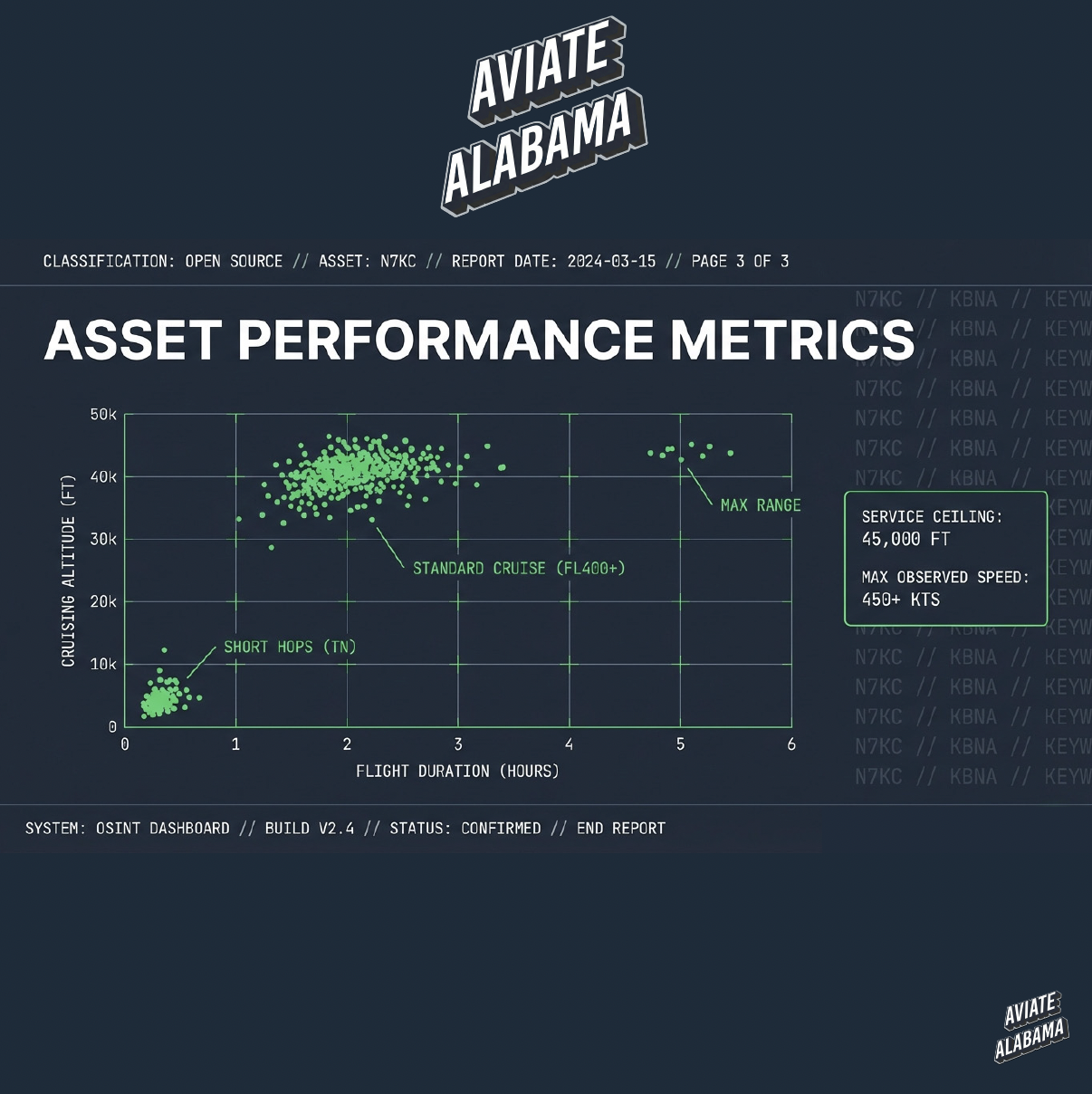
Kenny Chesney’s private aircraft, #N7KC, Asset Performance Metrics
The Hub That Makes Everything Work
Nashville International Airport (KBNA) is the fixed point around which Kenny Chesney's entire private aviation network orbits. Six years of flight data confirm it unambiguously — over 85% of all N7KC movements begin or end at KBNA. But what the data reveals beyond that simple fact is more interesting: Nashville isn't just a home base. It's a strategic launchpad that supports two completely different missions, often within the same 48-hour window.
From Nashville, Chesney's aircraft runs two distinct corridors. The first is the Western Continental Path — a stable, high-frequency bridge between Tennessee and Southern California, with a significant Las Vegas rotation emerging by 2025. The second is the Caribbean Maritime Corridor — a high-performance, high-altitude sprint across open ocean to the islands that have defined his life and his music for two decades. These are not the same kind of flight. The data makes that abundantly clear.
The Western Path: California, Burbank, and the Sphere
The California corridor is the workhorse of the operation. Westbound legs from Nashville to Camarillo (KCMA) — Chesney's primary West Coast staging base — run consistently between 4 hours 2 minutes and 4 hours 26 minutes. The return, aided by prevailing tailwinds, clocks in between 3 hours 18 minutes and 3 hours 42 minutes. Predictable, efficient, repeatable.
What the 2025 logs reveal is a tactical evolution within that corridor. Burbank (KBUR) begins appearing with increasing frequency in March and November 2025, displacing Camarillo as the primary LA metro entry point. Burbank puts you closer to the production infrastructure of the entertainment industry — studios, media companies, management offices. For an artist of Chesney's stature, who has announced five Las Vegas Sphere shows for June 2026, the timing of those Burbank flights suggests something larger was being assembled. The Sphere doesn't get built in a day, and the flight logs suggest Chesney wasn't waiting until 2026 to start the work.
The Las Vegas rotation confirms it. Beginning in May 2025 and running hard through June, the data shows rapid shuttle missions between KLAS and KCMA — short, purposeful hops between the Sphere's home city and his Southern California base. These are not leisure flights. This is pre-production movement, and the data's precision makes that conclusion difficult to avoid.
The Caribbean Corridor: Where the Songs Come From
If the California path is the professional machine, the Caribbean corridor is something else entirely. These flights are defined not by efficiency or predictability but by raw performance — extreme altitudes, maximum cruise speeds, and oceanic routing that takes the aircraft well beyond the reach of standard terrestrial radar.
The performance metrics from the Caribbean legs represent the true ceiling of what this aircraft can do. The Bahamas transit on August 27, 2021 logged a peak altitude of 46,575 feet. The June 2021 Mexico crossing hit 45,075 feet at 452 knots. An August 2022 leg to an oceanic coordinate point — no airport, no terminal, just a set of GPS coordinates over open water — peaked at 44,975 feet and 446 knots. These are not domestic cruise numbers. This is the aircraft being pushed to its limits to bridge the gap between mainland infrastructure and the remote island destinations that don't appear on commercial aviation maps.
That last detail matters. A significant number of Caribbean log entries show no airport code — just raw coordinates. Destinations in the Culebra and Luquillo areas of Puerto Rico, points near St. John in the U.S. Virgin Islands, oceanic waypoints with "Unknown" accuracy ratings because the aircraft has outpaced the terrestrial ADS-B network entirely. This is deliberate. Chesney has been deeply connected to St. John for years — an island with no commercial airport, accessible only by ferry or private helicopter from St. Thomas. The Charlotte Amalie (TIST) entries in the December logs are the last recorded waypoint before the island life begins.
Key West (KEYW) and Palm Beach (KPBI) function as tactical staging points — the final mainland stops before the aircraft goes oceanic. Florida is the transition zone, the last piece of established infrastructure before the Caribbean corridor opens up.
Two Missions, One Hub
What makes the Nashville axis genuinely remarkable is its ability to support both of these corridors within a compressed operational window. The logs show instances of a West Coast return and a Caribbean departure occurring within 48 hours of each other — KBNA absorbing the aircraft, turning it, and dispatching it in an entirely different direction toward an entirely different mission profile.
The contrast between the two corridors is stark when you put them side by side. The California path is a marathon — sustained 4-plus hour endurance legs at domestic altitudes, with ground-level ADS-B logs rated "Exact" from origin to destination. The Caribbean corridor is a sprint — short, violent altitude climbs to 40,000-plus feet, maximum speed profiles, oceanic tracking gaps, and coordinate-based destinations that require specialized navigation procedures the California legs never demand.
That difference places significantly higher mechanical stress on the aircraft during Caribbean missions. The performance bursts required to clear the oceanic routes efficiently represent the true limits of what N7KC was built to do — while the California path, by comparison, is almost leisurely.
What the Data Tells Us About the Life
For Kenny Chesney, the flight logs are a kind of autobiography that no interview has ever captured this cleanly. Nashville grounds him. California and Las Vegas drive the professional machine, increasingly oriented around what may be the most ambitious production of his career. And the Caribbean — always the Caribbean, at the outer limits of the aircraft's performance envelope, through oceanic tracking gaps, to coordinates that don't appear on any commercial map — that's where the rest of the story lives.
The data doesn't editorialize. It just shows you where the wheels went up and where they came down. And for six years, the pattern has been remarkably consistent: work west, escape south, and always come home to Nashville.
Analysis based on N7KC flight logs (2020–2026) | Verified source analysis by Aviate Alabama
